
Art Enthusiasts, Traditional Chinese Medicine Fans... How Do These Foreign Gen Z Enjoy Their Immersive Journey Through Shanghai?
"Upon arriving in Shanghai, the first thing I want to do is visit all the art exhibitions in the city," said Irene Bu, a Spanish graphic designer, as she gazed at the white boats passing by outside the window of the Maoma Warehouse (a former cotton and hemp warehouse) along the riverside. She was full of anticipation for her trip to Shanghai. "It would be a pity to come to Shanghai for the first time without exploring the art of this city. I downloaded WeChat beforehand and can use its translation function to read about the Shanghai exhibitions. It makes planning my itinerary so much easier!" Irene smiled as she showed the reporter her list of followed art museums on her phone and expressed her fascination with the recently opened "Chen Yifei Retrospective Exhibition".
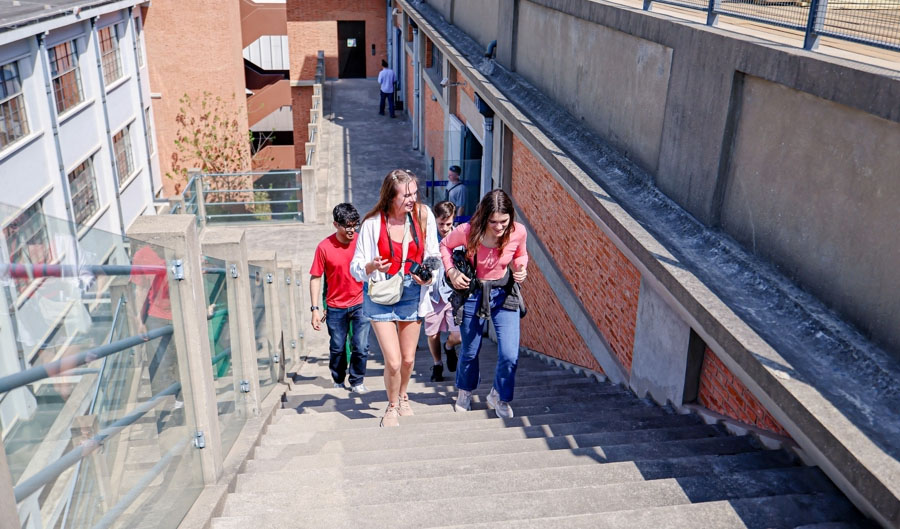
Irene was attracted to Chinese last year and began to learn it shortly after graduating from university. When asked about her proficiency in Chinese, she laughed and said, "Currently, I can say 'minute' in Chinese, but I still need to learn how to say 'second.' Here he is, a master of the Chinese language!" Matthew Smith from the UK immediately greeted in Chinese with a dramatic gesture, saying, "Nice to meet you!"
On April 15, the "Future Experience Officer Program—Global Gen Z Youth Exchange Salon" was held at the Le Cordon Bleu Global Brand Exhibition Center in Yangpu Riverside. The salon attracted more than 20 international Z-generation youths from the Americas and Europe. They gathered with students from Shanghai International Studies University, as well as Chinese and foreign youth journalists and editors from media platforms such as Wenhui Daily, Shanghai Daily, The Paper, and Sixth Tone. They engaged in sincere cross-cultural and intergenerational interactions around topics like "City Image Shaping," "Cultural Integration Practices," and "Global Communication Pathways."
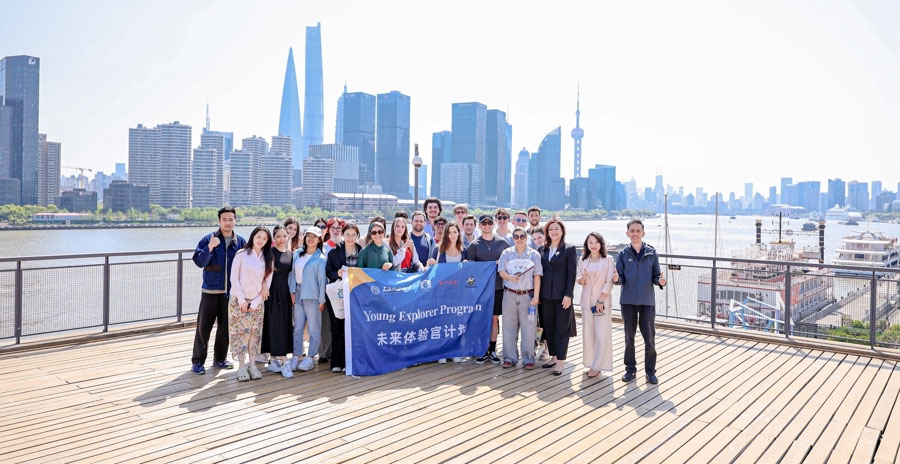
Fanning herself with a unique folding fan given by a traditional Chinese medicine clinic, Amelia Slater, a second-year student at the University of Oxford, enjoyed her life in Shanghai. "This morning, we went to a traditional Chinese medicine clinic in Hongkou District for a massage and acupuncture, and it felt really great!" she told the reporter with a smile, while mimicking the acupuncture movements.
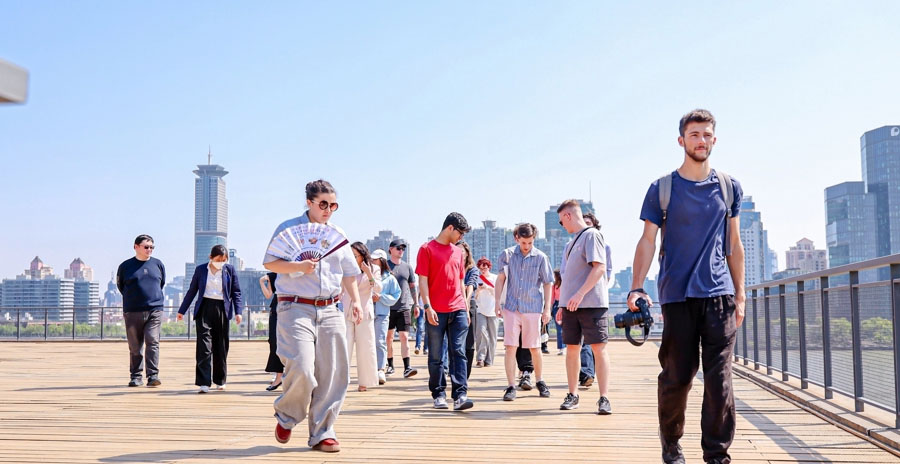
"I've been in Shanghai for several years now, but I still feel that kind of amazing sensation every day. There are so many diverse cultural activities happening here. If I miss one, I feel like, 'Oh, my gosh, there was such a cool event, and I didn't know about it,'" said Ma Hao, an Italian undergraduate student in Shanghai. Finding the city very welcoming, he registered for a Redbnote (a Chinese social media platform) account to "recommend" Shanghai life from the perspective of an international student to both Chinese and global users.
Amalia Garcia, a young woman from Spain, had traveled to Beijing, Nanjing, Hong Kong, and other places before coming to Shanghai. She likes to feel the city through a walk, and her approach is to experience its culture. During her few days in Shanghai, she said, "Shanghai has an international side, but it is also very friendly and inclusive. But this is not something someone told me; it is something I naturally felt after exploring, experiencing, and immersing myself in life here."

Indeed, this was the consensus among these Gen Z "experience officers." During their exchanges, they repeatedly mentioned that "true understanding comes from putting aside biases and experiencing things personally." Only by delving into the alleys and getting close to the people can one feel the most vibrant pulse of a city and experience the open, inclusive, and diverse cultural atmosphere that Shanghai presents.
This salon is an important part of the "Global Gen Z Youth Future Experience Officer" program. Initiated jointly by the School of Journalism and Communication at Shanghai International Studies University and the European Times UK Office, the program officially started on April 11 and lasted for 12 days. During this period, Gen Z youth from different countries and regions visited Shanghai and Hangzhou, exploring historical sites, intangible cultural heritage points, and emerging urban landmarks. Through field research, immersive experiences, and exchanges with Chinese and foreign youth, they will comprehensively understand traditional Chinese culture and perceive the development pulse and humanistic spirit of Chinese cities in the new era.
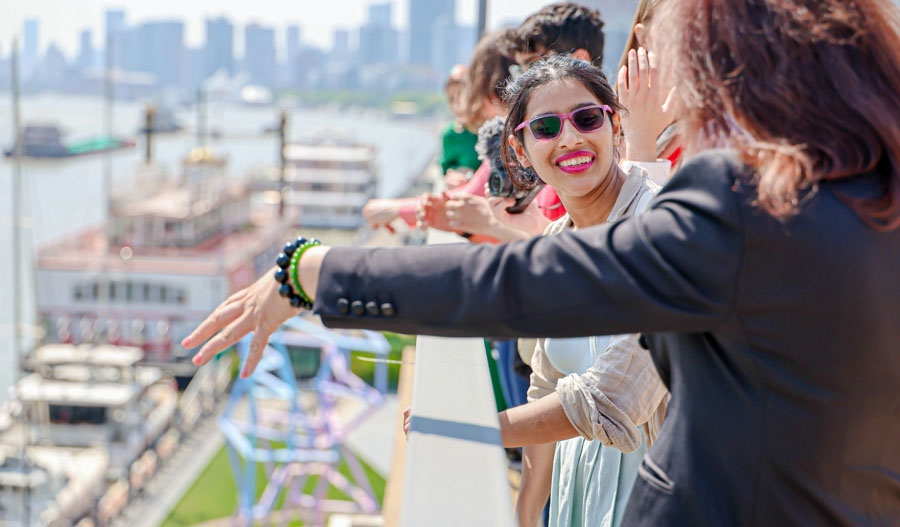
The event is co-organized by the School of Journalism and Communication at Shanghai International Studies University, the Shanghai Global News Network, and the European Times UK Office, with the co-sponsorship of the Yangpu Riverside Haijiao Industrial Innovation Promotion Center in Shanghai. This event has built a bridge for face-to-face communication between Chinese and foreign youth, and also motivated young people to contribute to the international dissemination of China's city image. This project will be held on a regular basis in the future. It will serve as a platform for young people from diverse cultures to interact and will assist global youth in growing together through mutual understanding and learning.
Source: SH Observer, Author: Wenhui Daily, Sun Yanyang