
Peking Opera at Fudan: A Journey into the Art of the Inner World
To promote the excellence of traditional Chinese culture and enrich the international students' campus life, the International Students Office and the Academic Affairs Office of Fudan University jointly launched a series of Chinese cultural experience activities in November. The series covered three major fields: pottery, acupuncture, and Peking Opera (Beijing Opera, 京剧). Each session invited renowned experts in the relevant field to provide instruction, combining theoretical explanation with hands-on practice, allowing students to immerse themselves in the profound heritage and vibrant charm of traditional Chinese culture.

Mentor: Zhao Qun, Professor at the Shanghai Theatre Academy, National First-Class Actress of China
Interpreter: Wang Ruigeng, Master's student at College of Foreign Languages and Literature, Fudan University
On the afternoon of November 13rd, over 20 international students from Fudan University, representing 17 countries, had their first encounter with the art of Peking Opera at the Temporary Student Activity Center on Handan Campus.
During the session, drawing on her decades of professional experience, Ms. Zhao Qun systematically introduced the fundamental aspects of Peking Opera to the students. Through vivid demonstrations of body movements, vocal techniques, and eye expressions, she showcased the unique charm of the four essential skills in Peking Opera—singing, speaking, acting, and acrobatics. This allowed the students to intuitively understand how this art form uses its stylized language to shape characters and convey emotions.

In the interactive segment, under Ms. Zhao's guidance, the students tried out basic Peking Opera steps, hand gestures, and simple body movements. Although their first attempts were a bit unfamiliar, they genuinely appreciated the intricacy and refinement of Peking Opera performance.
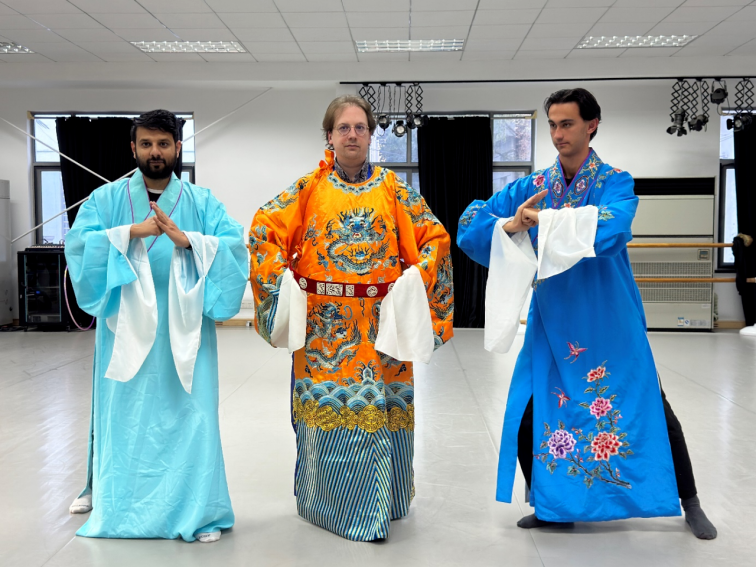
Ms. Zhao also shared insights from her artistic journey with the students. She emphasized that Peking Opera values the unity of form and spirit, requiring performers to undergo long-term and diligent training to accurately portray characters and express inner emotions. She encouraged the students to approach traditional culture with an open mind and to experience the profound humanistic spirit it embodies.

Le Bailly Mathias
School of International Relations and Public Affairs, Doctoral student
This Peking Opera workshop offered us much more than passive observation; it was an immersive dive into a profound artistic tradition. Under Ms. Zhao's guidance, we attempted basic steps, postures, and movements. The experience was humbling. Coordinating our limbs and handling the props proved challenging, yet this very difficulty deepened our respect for the years of disciplined practice behind every opera professional.
What truly captivated us was Ms. Zhao's demonstration. Without elaborate costumes or sets, she conjured vivid characters (such as an emperor, a maiden, or a general) through the subtleties of her gaze, gesture, and posture. She explained that the essence of Peking Opera lies in conveying spirit through form, where the eyes serve as a window to the character's soul. We came to appreciate it not merely as performance, but as a sophisticated philosophy of expressing universal human emotions through codified artistry.
Furthermore, Ms. Zhao's candid discussion about the contemporary realities and future of Peking Opera provided valuable perspective. It prompted us to reflect on a universal cultural challenge: how ancient arts evolve while preserving their core identity. For us international students, this was more than an introduction to a Chinese art form; it was a meaningful cross-cultural dialogue. The Peking Opera highlights how aesthetic and emotional expression can transcend language, and how the enduring power of traditional arts lies in their ability to connect us across time and cultures through shared human resonance.
Cédric Bourgeois-Potage
School of International Relations and Public Affairs, Master's student
As a French opera enthusiast, I was truly captivated by this Peking Opera experience, which felt entirely distinct from its European counterpart. What I enjoyed most was trying out the various props and learning the basic steps—by the end, I almost felt like I had transformed into a Chinese opera performer myself. This workshop gave me a delightful and surprisingly intimate first glimpse into Chinese theatrical art. I now genuinely hope to attend a live performance someday.
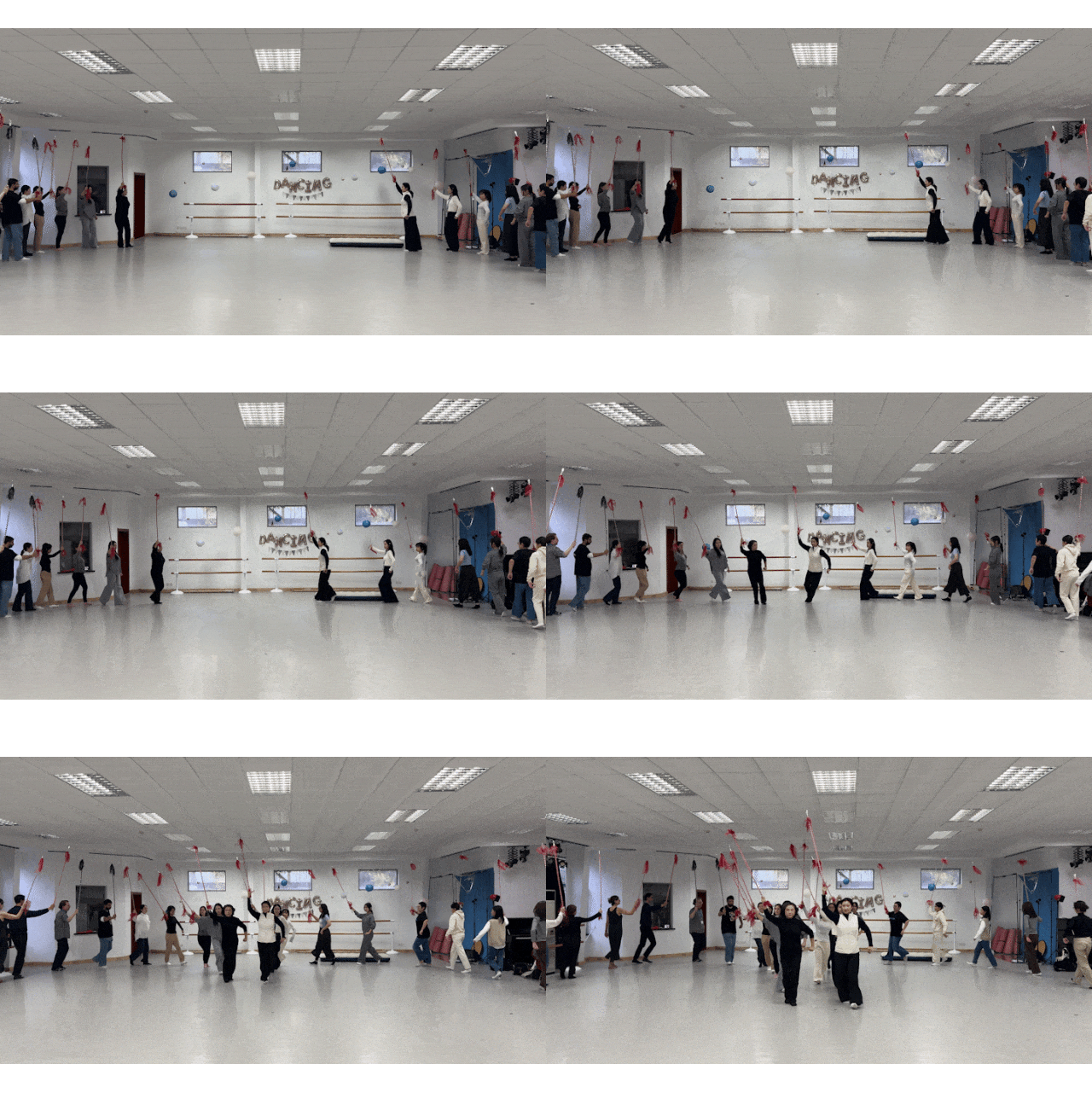
Through this immersive Peking Opera workshop, international students at Fudan University gained a genuine appreciation of this traditional art form. More than an artistic encounter, it became a meaningful dialogue between civilizations. With its unique Eastern charm, this cultural treasure has built a bridge of understanding and mutual learning among students from across the world.
Source: Fudan University